Google has announced that GWT 1.3 RC is now completely open source under the Apache 2.0 licence.
This coming right after Yahoo released their User Interface Library and Tibco their General Interface AJAX Library under an open source BSD licence (though GI does have a commercial licence too) seems to indicate an interesting trend in the industry. That's three big names in rich web application development choosing to go open source in the last year.
Of course, there is open source and open source. One kind has a community contributing to it (scriptaculous, dojo), the other does not. The question is how far toward the community model are each of these projects prepared to go and if they see any value in making such a move.
A quick look at the GI website showed no obvious links for those interested in contributing. Yahoo and Google are rather more 'open' as their source is available for checkout from their Subversion repositories on Sourceforge and Google Code respectively, with very clear directions on how to do so (well, actually the instructions are from Sourceforge and Google Code but whatever). They however cannot yet be categorized as community projects. Indeed in contrast to, say, scriptaculous' large and lively community of contributors and clear instructions on their wiki on how to contribute, the most active community participation on the others seems to be in the user groups.
I took a look at YUI's patch submissions on sourceforge and there were a measly dozen or so patches contributed. GWT is way too new - we'll have to wait and watch. And like I said, there seems to be no obvious way to contribute to GI, though Tibco does have a developer network where they ask users to contribute to the discussions and feedback.
Update: 20061215, 0905
As Kevin Hakman from Tibco points out, GI is being rolled out in three phases, the last of which allows contributors to submit their code. I suppose this puts GI in the same 'wait and watch' category as GWT.
Update: 20061220, 1930
I'm not posting past 3am again when I'm too knackered to research effectively. Read this page at the GWT site on how to contribute, among other things. Now I guess it's just a question of which one (or more than one) of these projects the community picks up and runs with and how much this benefits the project over and above the obvious one of bugs being spotted early.
Showing posts with label YUI. Show all posts
Showing posts with label YUI. Show all posts

A beginner's guide to javascript libraries
http://codecraft.info/index.php/archives/58/
The comments also introduce jQuery which looks quite interesting.
Update: 20061126, 0230
As my colleague Sudhindra pointed out in his comment, I did miss out behaviour.js which allows you to write much cleaner HTML. Funny he mentions it, because I have a post on a behaviour.js hack to reapply styles to dynamically added or modified DOM elements - something which most AJAX apps tend to do - sitting in the Drafts section of my blog for almost a month now pending my figuring out how to post HTML markup on blogger (something I complain about in my very next post!).
The comments also introduce jQuery which looks quite interesting.
Update: 20061126, 0230
As my colleague Sudhindra pointed out in his comment, I did miss out behaviour.js which allows you to write much cleaner HTML. Funny he mentions it, because I have a post on a behaviour.js hack to reapply styles to dynamically added or modified DOM elements - something which most AJAX apps tend to do - sitting in the Drafts section of my blog for almost a month now pending my figuring out how to post HTML markup on blogger (something I complain about in my very next post!).
Yahoo YUI integration with GWT
I'm working on this mostly to get familiar with JSNI and structuring in GWT. The sample is far from complete, but it's enough if all you want is the JSNI to interface with YUI's DragDrop. All you need to look at are the Draggables and Droppables classes and the DragDropListener interface.
The code is grossly over-complicated for its intended function, but I don't really care since I'm trying to familiarise myself with a few concepts.
Download the sample app here.
I'm hosting the download on geocities (for the moment) which has a 4MB per hour limit on downloads. I doubt I'll hit that but I figure you should know, just in case...
I'll be posting updates as I work on the code. All the zips are date-time stamped; I guess that'll work just fine as a version number.
You'll also need to download GWT if you want to try it out for yourself. You'll need to change the path in the GWT shell launcher batch file in the sample to point to your GWT install directory.
Update: 20061124, 0200
I created a code.google.com thingie. Pretty painless, compared to Sourceforge. And it uses Subversion (hurray!). Of course, there's no built in distribution mechanism like Sourceforge has - not that I could find anyways. I'll add the date-time stamp to the changelog. Check it out; no pun intended. - http://code.google.com/p/ygwt/
Update: 20061124, 2315
This is in response to Andy's comment:
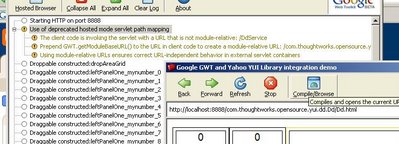
Andy, here is a shot of how the GWT shell looks after launching the app from the batch file. For me, the 'deprecated hosted mode' message is just a warning, not an error. I've built this example with 1.2.22 too. Is it possible you're getting an exception somewhere further down the line?
Update: 20061129, 0130
I've been checking code into the Google Code repository fairly often. Will produce another downloadable sample when I've finished the contraints for the drop area grid.
Update: 20061218, 2115
I'd been unable to run unit tests on this IDEA project for a while (it would just refuse compile) and it'd been annoying me no end. Well I found the solution buried in the fifth reply to a post on the GWT mailing list a couple of weeks ago... all I had to do was add
to my gwt.xml - so now I'm chugging away with unit tests! Forgot to post this update earlier. This code sample now seems to also be describing my understanding of MVC and how to implement it in GWT. I'm doing a fair amount of refactoring as my understanding progresses. It's a bit over-designed given the simple nature of the problem, but it's fun to try new ideas out.
The code is grossly over-complicated for its intended function, but I don't really care since I'm trying to familiarise myself with a few concepts.
Download the sample app here.
I'm hosting the download on geocities (for the moment) which has a 4MB per hour limit on downloads. I doubt I'll hit that but I figure you should know, just in case...
I'll be posting updates as I work on the code. All the zips are date-time stamped; I guess that'll work just fine as a version number.
You'll also need to download GWT if you want to try it out for yourself. You'll need to change the path in the GWT shell launcher batch file in the sample to point to your GWT install directory.
Update: 20061124, 0200
I created a code.google.com thingie. Pretty painless, compared to Sourceforge. And it uses Subversion (hurray!). Of course, there's no built in distribution mechanism like Sourceforge has - not that I could find anyways. I'll add the date-time stamp to the changelog. Check it out; no pun intended. - http://code.google.com/p/ygwt/
Update: 20061124, 2315
This is in response to Andy's comment:
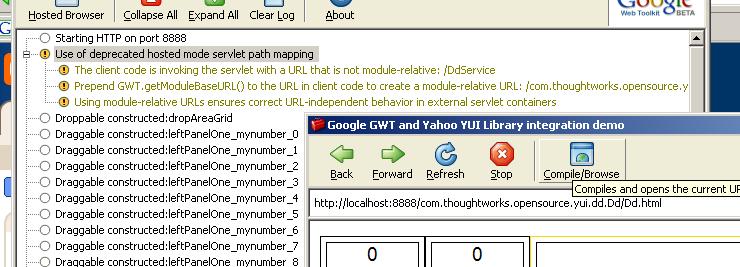
Andy, here is a shot of how the GWT shell looks after launching the app from the batch file. For me, the 'deprecated hosted mode' message is just a warning, not an error. I've built this example with 1.2.22 too. Is it possible you're getting an exception somewhere further down the line?
Update: 20061129, 0130
I've been checking code into the Google Code repository fairly often. Will produce another downloadable sample when I've finished the contraints for the drop area grid.
Update: 20061218, 2115
I'd been unable to run unit tests on this IDEA project for a while (it would just refuse compile) and it'd been annoying me no end. Well I found the solution buried in the fifth reply to a post on the GWT mailing list a couple of weeks ago... all I had to do was add
<inherits name='com.google.gwt.junit.JUnit'/>
to my gwt.xml - so now I'm chugging away with unit tests! Forgot to post this update earlier. This code sample now seems to also be describing my understanding of MVC and how to implement it in GWT. I'm doing a fair amount of refactoring as my understanding progresses. It's a bit over-designed given the simple nature of the problem, but it's fun to try new ideas out.
"Too much recursion"
That's the Javascript error I'm getting on Firefox when I run my GWT app. It works fine on IE, though. And here I was hoping to be done with my YUI based GWT drag-drop example in a day or two. No point in continuing unless I can get it working on FF, though.
It looks like an equals() function is being called recursively somewhere. Debugging generated javascript is a total nightmare. Oh well, back to work...
Update (20061123,1910):
Got it working. Of all the dumb things, it was a call to the toString() function of a GWT JavaScriptObject instance in my Java code. Commented it out and everything runs fine.
It looks like an equals() function is being called recursively somewhere. Debugging generated javascript is a total nightmare. Oh well, back to work...
Update (20061123,1910):
Got it working. Of all the dumb things, it was a call to the toString() function of a GWT JavaScriptObject instance in my Java code. Commented it out and everything runs fine.
Subscribe to:
Posts (Atom)